
Every time I cook a roast, I plan it all in advance. Chicken cook time, veg prep time, all of it. And every time, without fail, I forget to account for parboiling the potatoes, adding an extra half hour or so. So, so frustrating.
Poetry
I rarely ever listen to or pay any real attention to lyrics in songs, not consciously at least. I’ll find myself singing them later, so at least some part of my brain does, but in the moment I’m focusing on how they fit into the song. The melody, the rhythm, the harmonies behind it, the place each have in the mix. One big soundscape.
It’s why I listen to a fair amount of non-English language songs, largely J-rock or J-pop, with a smattering of other European countries. On the other hand, it’s also why I’ve long struggled to write lyrics to any songs I’ve written. I can hear the cadence in my head, beat it out on the desk, but any time I put pen to paper it just feels hollow. Devoid of meaning, just words for the sake of words.
On the other side, there was poetry. That I could do.
One of the reasons I keep some kind of notebook with me at all times is I’ll get just snippets pop up in my head. Two or three lines of rhymes or feelings, a snippet of dialogue, a direction in which to go. Every now and then I’d review them, see which ones still have a place in my brain, and try and flesh it out.
And I was kind of okay at it. Put some online, got some praise. In particular a war one I wrote around Remembrance Day that I can neither find nor remember. I’d do open mic nights locally and not totally bomb, which is a solid minimum result. Then I just kind of stopped.
One of the things I’ve been trying to do a lot more recently is avoid over intellectualising things; change course from treating everything like it’s a deep intellectual puzzle that needs analysis and just see if the surface diagnosis fits. In this case, it is that simple: the open mic night closed, so I fell out of that routine, depression and neurodivergence did their work on distracting me from it, and I never allowed myself to go deep in process. It didn’t worm its way into my core.
And I was alone. Not truly, I had friends, I have family, but on this I was alone. I had no friends trying to do the same thing, no mentor I could learn from, and I didn’t have the social skills to try and make one. I was ‘on the breadline’ poor, so taking classes was out of the question, and while there were libraries and books, I had no idea what I was looking for, especially as I was so wrapped up in my perfectionist ‘I can do all the things if I try’ mindset.
But times change and so do I. I may not be surrounded still by poets and artists, but I can change that, even if it’s digital interactions over physical in the short term. I can lean back into my curiosity, expand myself out there again. I’ve got my Zettelkasten ready to accept snippets to flick through, and collect snippets from poetry that resonates with me. And I’ve got a much better selection of research tools than I did 15 years ago, not to mention a much better understanding of my self, how I tick, and how to get around my shortcomings.
I need to finish the three books I currently have on the go, but after that, I’ll be buying/adding A Poetry Handbook by Mary Oliver and How to Write One Song by Jeff Tweedy as a starting point. Then we’ll go from there.
Skill Gap
The thing about being a relatively busy adult with a load of responsibilities whilst dealing with neurodiversity issues is that it’s really easy to lose sight of the fun and creative hobbies you want to do. This then leads to the skills behind these hobbies atrophying, creating the dreaded skill gap - the distance between what you can do, and what you want to do.
I feel this most with my guitar playing. I’ve been playing on and off for nearly 20 years, but I would say my skills are trapped in that state of high beginner. Theoretically, I can hang at an intermediate level. Modes, positions, fingerboard awareness, extended chords and how to use them. All in my brain ready to use. I just can’t back it up.
I can definitely play, and play rhythm fairly fast and accurate; I can follow along at around 160bpm, and I can sort of solo. Improvisation is an area I often fail in outside of a pure flow state, usually because all I can hear in my head when I’m trying to solo over a backing track is the original solo (or a live recorded version).
Then there’s the fiddly bits. My bends aren’t 100% accurate and I struggle to put vibrato on them. I can hammer on/pull off pretty cleanly up to about 100bpm in quarter notes, but not much further or faster, and not for more than say 4 to 6 bars. Slides often get a bit blurry if I try to apply speed so the target note gets lost. Then there’s the speed picking issue, plus the fact that I struggle above the 15th fret in any position really.
Combine that with the tendency to play unplugged and I’m left with the inability to turn the sounds in my head into reality.
There are other hobbies I’ve let atrophy, or ones that I want to start picking up, that are similarly easy enough to assess the skills gap. The one I struggle with though is writing. How do you assess something essentially subjective? There’s no real 16th note alternate picking or speed legato playing equivalent in the art of writing, outside of perhaps grammar, and even then, there’s ways around it. Hello, Claude.
Experience has told me that unless it’s universally disliked, writing is difficult to qualify. Low effort, badly written books can still pick up a fan base, whilst highly rated best sellers still have their detractors. For example, I’ve personally tried and failed to read One Hundred Years of Solitude 3 times; I just can’t get on board with it. See also: Rivals by Jilly Cooper, a book that seemed more interested in introducing the 6 page glossary of characters than writing about any of the things said characters actually do on the daily, other than cheat on their partners.
ChatGPT (whose grammar opinions I trust less than Claude, for reasons, although I find it better for general purpose use) tells me to try and assess things like storytelling and structure, narrative pacing, scene construction, but again, being a relative novice at this how would I know? Then there’s the directions I want to push into more - poetry, story writing, etc.
Of course, the answer is simple: I find out by doing the thing. Start writing poetry. Start writing more fiction. Make it more of a daily habit. Then assess it. Pick up things I struggle with, just like I notice the struggle adding vibrato to a string bend.
More importantly, stop using the unknown or unknowable as a reason to not do the thing, or even learn more about doing the thing.
My pencils are sharp enough.
Not overly impressed with the new Tame Impala album on the first go. A few tracks stood out, but it kind just melded into one after a while. Definitely has a vibe, will need to give it a re-listen.
The Muscle Ladder by Jeff Nippard 📚
ChatGPT nailed this one on the head when I asked it to review and make it’s recommendation to me on a buy/not buy decision. I won’t copy/paste the whole response, but it can be summarised as ‘very good at explaining the why, decent beginners output, but for the more experienced lifters it contains information you can find elsewhere.’
That last point I think is the key problem for fitness books everywhere. They seem to either pedal a ‘novel’ approach with limited research, or jazz up the existing information in their own style, obscuring the science stuff with buzzwords and phrases. Plus in 2025, it’s so, so easy to find all the information you need for free online, especially in the age of AI when you can just ask ChatGPT to assess your diet and exercise routine, or recommend a whole new thing for you.
With that being said, why would you then spend money on a book for info you can gain for free?
One reason would be the author, which in this case is science based weightlifter and YouTuber Jeff Nippard. He’s one of the few fitness YouTubers I follow and enjoy; his explanations go into just enough detail to explain the concept without getting too bogged down in the jargon. Plus he has a way of suggesting tweaks to exercises that just work, like switching your dumbbell curls to incline curls or even better, preacher curls, to maximise effectiveness.
Another would be how the information is presented, which is what became the killer aspect for me. As fitness books go, The Muscle Ladder hits the perfect balance of detail and readability. The title of the book is the one and only buzzword for the book; a series of steps towards a leaner, bigger, better physique that, like a ladder, relies on the rungs before your current step being set up just right (alongside the two rails). It also cites its sources, which alone takes up 30 pages of the ebook.
All of that adds up to a book that’s probably helped the way I think about fitness more than any doctor, blog, youtuber, or scheme before hand. In particular, it goes into great detail how to structure a routine: exercises to pick per muscle group, worked sets needed per muscle per week across the various difficulty levels, effective rep ranges and rest periods, the lot.
The main detractor against it is its price. The hardcover RRP is £56.99, although it’s often on offer. That’s a pretty hefty price, and if I had pain that, I might have been a bit more critical. Happily, the ebook was a tenner, and I feel like I’ve more than got my money’s worth.
Like How To Take Smart Notes, its true worth is going to be measured down the line, after I’ve had time to implement its recommendations. It doesn’t provide a nutrition plan but does give recommendations for working out your calorie and macro requirements. It also comes with a range of exercise plans and routines for different abilities or goals, although I’ll be going with my own to test out the rest of the theory.
For now though, I’d give the ebook a solid 8 out of 10, would recommend to anyone looking to take their fitness seriously. The last 2 points will come if I actually get results through it…
I love it when my stationery orders come with a hand written thank you card. Immediately makes me a customer for life.
Finished The Muscle Ladder last night. That’s 12 books for the year, 3 books since starting the blog. Solid pace.
An Actual Opponent
Practicing snooker alone has revealed significant flaws in my game when competing against an actual opponent, but despite losing, I remain optimistic and encouraged by the experience.
Outside of the sub-par intro, loved the new Ranma 1/2. Missed that show so much, the new op just doesn’t hit the same.

Great line from this months ToDoist email - ‘too much learning without an outlet can lead to overload’. Really verbalised a thought I’ve been circling for a while.
September Review
Ok, it’s been a month. Let’s check how I’ve been doing.
Quick refresher: the aim of the blog is to make me publicly accountable for actually progressing in my hobbies, alongside using Beeminder to fine me if I miss the goal. The three I’m currently tracking and their monthly targets are:
- Reading: Finish one book per month
- Writing: Write four posts here per month covering one of the activities (500 word minimum)
- Pool/snooker - play/practice five times a month
✅ Reading
Two books finished - What you are looking for is in the Library by Michiko Aoyama, and How To Take Smart Notes by Sonkë Ahrens . I also have four books currently on the go:
- Leonardo Da Vinci by Walter Isaacson on Audible
- The Muscle Ladder by Jeff Nippard on the Kindle app on my iPad
- Four Hour Work Week by Tim Ferriss on Kindle
- The Remains of the Day by Kazuo Ishiguro
I think I’m likely to complete two, maybe three this month, so I’m doing pretty good here.
✅ Writing
Got my four posts in pretty easily:
- Reading in progress
- What you are looking for is in the library by Michiko Aoyama
- As yet untitled
- How To Take Smart Notes by Sonkë Ahrens
Although I did have a lot of annual leave, so I’m hoping to keep the momentum going now I’m back at work.
✅ Pool/Snooker
Managed six sessions, although again that was during my time off.
Beeminder
All of the above means my Beeminder charts are all well ahead of the dreaded red lines, so no fines for me this month. I did allow a limited grace period assuming I might be slow to hit the reading target in the first week or so given that I was targeting a book read in a month.
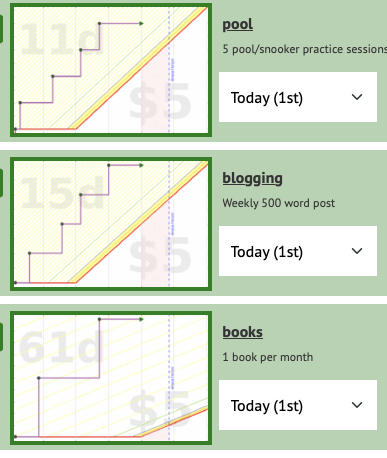
Importantly though I am feeling good about this so far. It’s forcing me to focus on what I want to do, not just what I should, and encouraging me to publish ideas no matter how half baked they may be. Looking forward to seeing what October brings.
One of the things I’ve picked up from The Muscle Ladder that’s most relevant to me is that I consistently underestimate what I can actually lift in a set. I figured my leg press for example maxes around 6 reps of 160kg. I just pushed out 18 reps at 200kg. Quads sufficiently blitzed.
Saw Barbie 🍿last night. Can’t help but feel the ending would have stuck better if the Creator did the emotional labour with Ken, not Barbie. It feels like Barbie doing the whole ‘be Ken’ speech reverses the message of ‘women don’t owe this to men’, and dodges the idea that that’s how Ken was made.
How To Take Smart Notes by Sonkë Ahrens 📚
Initially after finishing this one, I was expecting to be pretty harsh.
Reading the middle third and parts of the last one was an absolute slog. I had to check where I was multiple times to make sure I wasn’t re-reading passages over and over, such was the repetitive feel of it. Constant iterations of the idea that the slip box was more than the sum of its parts, that using it was more akin to a conversation between participants than searching an encyclopaedia. Analogy after analogy of repeating the same idea, slightly differently. At one point I nearly gave up.
But then I reviewed my notes and highlights, started following the ideas a little, and began to think differently.
How To Take Smart Notes feels less like an instruction manual and more like a manifesto; a Why To rather than of a How To. It introduces you to the concept of Zettelkasten (literally “note-box” in German), which the book calls a slip box, the note-taking and personal knowledge management system used by Niklas Luhmann, a hugely influential and prolific sociologist who used it to publish 50 books and over 600 articles. What its real and oft-repeated message is, however, is to treat everything as though writing is the end goal.
The art of Zettelkasten is based around its simplicity: take fleeting (temporary) notes throughout your day, collect them in an inbox (either real or digital), then review regularly. Translate the notes that are relevant to your interests into permanent notes for your slip box, reviewing your slip box for connections to existing notes or ideas. If there are connections, you’d place your note directly behind the note it connects to and include a link on each note. Else, put the note at the back of the slip box. Similarly, when reading texts and articles, take notes as you go for a separate bibliography, and translate takeaway notes into the slip box.
The idea here is to remove responsibility for this from your brain and into a trusted system. It’s far from a unique idea; Tiago Forte has his own version in Building a Second Brain, and the book itself makes multiple references to David Allen’s Getting Things Done system. But the other aim is to do as Luhmann did - build a system of connected notes, regularly engage them with new ideas, new connections, and new questions to be answered off the back of them, and build a critical mass of notes with a view to ultimately write your own text off the back of them, fully sourced and detailed in your slip box and bibliography.
It’s at this point you might ask yourself why would this be relevant to you, especially if you’re not in the academic writing world. The author answers this in the later chapters by pointing out the headfake - it’s not a requirement to use it to become a published academic or novelist, but when writing and taking notes with the aim of creating a written work in mind, you naturally build a working network of ideas and thoughts, carefully crafted and challenged over time, developing a much more effective method of thinking and learning than, as they write, ‘hammering facts into the brain as if they were carvings on an ancient stone tablet’.
It’s perhaps fitting then that I got more out of reading my highlights and notes on the text than I did through my initial read through. Zettelkasten wasn’t a new idea to me going into it, and I think there are perhaps better resources for the method than this book (the introduction at zettelkasten.de, for example). Luhmann’s actual linking method of using numbers and letter to identifies chains and branches isn’t really explored until the appendix, for example, a choice I assume is related to their approach of trying to keep the method as system agnostic as possible. They make no recommendation or preference for whether you use pen and paper, or digital tools; letter and numbers, or markdown hyperlinks. Their goal is simply to get you taking smart notes and to give you the tools and ideas to help your own thoughts and ideas grow.
It’s definitely not a book for everyone, maybe not even everyone deeply interested in PKM. Even for a relatively short book, it wasn’t quick to get through, or consistently enjoyable. Yet I’ve gotten a lot from it, including inspiration for my own way forward, and it’s a book I’ll likely revisit in later months or years to refresh my mind and top up my notes on it. Maybe the rating will change with revisits, but for now?
6/10