
2025
The Muscle Ladder by Jeff Nippard 📚
ChatGPT nailed this one on the head when I asked it to review and make it’s recommendation to me on a buy/not buy decision. I won’t copy/paste the whole response, but it can be summarised as ‘very good at explaining the why, decent beginners output, but for the more experienced lifters it contains information you can find elsewhere.’
That last point I think is the key problem for fitness books everywhere. They seem to either pedal a ‘novel’ approach with limited research, or jazz up the existing information in their own style, obscuring the science stuff with buzzwords and phrases. Plus in 2025, it’s so, so easy to find all the information you need for free online, especially in the age of AI when you can just ask ChatGPT to assess your diet and exercise routine, or recommend a whole new thing for you.
With that being said, why would you then spend money on a book for info you can gain for free?
One reason would be the author, which in this case is science based weightlifter and YouTuber Jeff Nippard. He’s one of the few fitness YouTubers I follow and enjoy; his explanations go into just enough detail to explain the concept without getting too bogged down in the jargon. Plus he has a way of suggesting tweaks to exercises that just work, like switching your dumbbell curls to incline curls or even better, preacher curls, to maximise effectiveness.
Another would be how the information is presented, which is what became the killer aspect for me. As fitness books go, The Muscle Ladder hits the perfect balance of detail and readability. The title of the book is the one and only buzzword for the book; a series of steps towards a leaner, bigger, better physique that, like a ladder, relies on the rungs before your current step being set up just right (alongside the two rails). It also cites its sources, which alone takes up 30 pages of the ebook.
All of that adds up to a book that’s probably helped the way I think about fitness more than any doctor, blog, youtuber, or scheme before hand. In particular, it goes into great detail how to structure a routine: exercises to pick per muscle group, worked sets needed per muscle per week across the various difficulty levels, effective rep ranges and rest periods, the lot.
The main detractor against it is its price. The hardcover RRP is £56.99, although it’s often on offer. That’s a pretty hefty price, and if I had pain that, I might have been a bit more critical. Happily, the ebook was a tenner, and I feel like I’ve more than got my money’s worth.
Like How To Take Smart Notes, its true worth is going to be measured down the line, after I’ve had time to implement its recommendations. It doesn’t provide a nutrition plan but does give recommendations for working out your calorie and macro requirements. It also comes with a range of exercise plans and routines for different abilities or goals, although I’ll be going with my own to test out the rest of the theory.
For now though, I’d give the ebook a solid 8 out of 10, would recommend to anyone looking to take their fitness seriously. The last 2 points will come if I actually get results through it…
I love it when my stationery orders come with a hand written thank you card. Immediately makes me a customer for life.
Finished The Muscle Ladder last night. That’s 12 books for the year, 3 books since starting the blog. Solid pace.
An Actual Opponent
Practicing snooker alone has revealed significant flaws in my game when competing against an actual opponent, but despite losing, I remain optimistic and encouraged by the experience.
Outside of the sub-par intro, loved the new Ranma 1/2. Missed that show so much, the new op just doesn’t hit the same.

Great line from this months ToDoist email - ‘too much learning without an outlet can lead to overload’. Really verbalised a thought I’ve been circling for a while.
September Review
Ok, it’s been a month. Let’s check how I’ve been doing.
Quick refresher: the aim of the blog is to make me publicly accountable for actually progressing in my hobbies, alongside using Beeminder to fine me if I miss the goal. The three I’m currently tracking and their monthly targets are:
- Reading: Finish one book per month
- Writing: Write four posts here per month covering one of the activities (500 word minimum)
- Pool/snooker - play/practice five times a month
✅ Reading
Two books finished - What you are looking for is in the Library by Michiko Aoyama, and How To Take Smart Notes by Sonkë Ahrens . I also have four books currently on the go:
- Leonardo Da Vinci by Walter Isaacson on Audible
- The Muscle Ladder by Jeff Nippard on the Kindle app on my iPad
- Four Hour Work Week by Tim Ferriss on Kindle
- The Remains of the Day by Kazuo Ishiguro
I think I’m likely to complete two, maybe three this month, so I’m doing pretty good here.
✅ Writing
Got my four posts in pretty easily:
- Reading in progress
- What you are looking for is in the library by Michiko Aoyama
- As yet untitled
- How To Take Smart Notes by Sonkë Ahrens
Although I did have a lot of annual leave, so I’m hoping to keep the momentum going now I’m back at work.
✅ Pool/Snooker
Managed six sessions, although again that was during my time off.
Beeminder
All of the above means my Beeminder charts are all well ahead of the dreaded red lines, so no fines for me this month. I did allow a limited grace period assuming I might be slow to hit the reading target in the first week or so given that I was targeting a book read in a month.
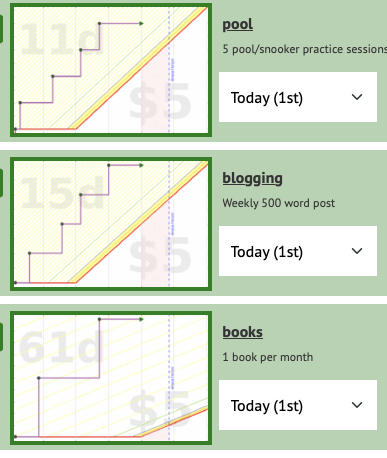
Importantly though I am feeling good about this so far. It’s forcing me to focus on what I want to do, not just what I should, and encouraging me to publish ideas no matter how half baked they may be. Looking forward to seeing what October brings.
One of the things I’ve picked up from The Muscle Ladder that’s most relevant to me is that I consistently underestimate what I can actually lift in a set. I figured my leg press for example maxes around 6 reps of 160kg. I just pushed out 18 reps at 200kg. Quads sufficiently blitzed.
Saw Barbie 🍿last night. Can’t help but feel the ending would have stuck better if the Creator did the emotional labour with Ken, not Barbie. It feels like Barbie doing the whole ‘be Ken’ speech reverses the message of ‘women don’t owe this to men’, and dodges the idea that that’s how Ken was made.
How To Take Smart Notes by Sonkë Ahrens 📚
Initially after finishing this one, I was expecting to be pretty harsh.
Reading the middle third and parts of the last one was an absolute slog. I had to check where I was multiple times to make sure I wasn’t re-reading passages over and over, such was the repetitive feel of it. Constant iterations of the idea that the slip box was more than the sum of its parts, that using it was more akin to a conversation between participants than searching an encyclopaedia. Analogy after analogy of repeating the same idea, slightly differently. At one point I nearly gave up.
But then I reviewed my notes and highlights, started following the ideas a little, and began to think differently.
How To Take Smart Notes feels less like an instruction manual and more like a manifesto; a Why To rather than of a How To. It introduces you to the concept of Zettelkasten (literally “note-box” in German), which the book calls a slip box, the note-taking and personal knowledge management system used by Niklas Luhmann, a hugely influential and prolific sociologist who used it to publish 50 books and over 600 articles. What its real and oft-repeated message is, however, is to treat everything as though writing is the end goal.
The art of Zettelkasten is based around its simplicity: take fleeting (temporary) notes throughout your day, collect them in an inbox (either real or digital), then review regularly. Translate the notes that are relevant to your interests into permanent notes for your slip box, reviewing your slip box for connections to existing notes or ideas. If there are connections, you’d place your note directly behind the note it connects to and include a link on each note. Else, put the note at the back of the slip box. Similarly, when reading texts and articles, take notes as you go for a separate bibliography, and translate takeaway notes into the slip box.
The idea here is to remove responsibility for this from your brain and into a trusted system. It’s far from a unique idea; Tiago Forte has his own version in Building a Second Brain, and the book itself makes multiple references to David Allen’s Getting Things Done system. But the other aim is to do as Luhmann did - build a system of connected notes, regularly engage them with new ideas, new connections, and new questions to be answered off the back of them, and build a critical mass of notes with a view to ultimately write your own text off the back of them, fully sourced and detailed in your slip box and bibliography.
It’s at this point you might ask yourself why would this be relevant to you, especially if you’re not in the academic writing world. The author answers this in the later chapters by pointing out the headfake - it’s not a requirement to use it to become a published academic or novelist, but when writing and taking notes with the aim of creating a written work in mind, you naturally build a working network of ideas and thoughts, carefully crafted and challenged over time, developing a much more effective method of thinking and learning than, as they write, ‘hammering facts into the brain as if they were carvings on an ancient stone tablet’.
It’s perhaps fitting then that I got more out of reading my highlights and notes on the text than I did through my initial read through. Zettelkasten wasn’t a new idea to me going into it, and I think there are perhaps better resources for the method than this book (the introduction at zettelkasten.de, for example). Luhmann’s actual linking method of using numbers and letter to identifies chains and branches isn’t really explored until the appendix, for example, a choice I assume is related to their approach of trying to keep the method as system agnostic as possible. They make no recommendation or preference for whether you use pen and paper, or digital tools; letter and numbers, or markdown hyperlinks. Their goal is simply to get you taking smart notes and to give you the tools and ideas to help your own thoughts and ideas grow.
It’s definitely not a book for everyone, maybe not even everyone deeply interested in PKM. Even for a relatively short book, it wasn’t quick to get through, or consistently enjoyable. Yet I’ve gotten a lot from it, including inspiration for my own way forward, and it’s a book I’ll likely revisit in later months or years to refresh my mind and top up my notes on it. Maybe the rating will change with revisits, but for now?
6/10
That’s book 2 finished - How To Take Smart Notes. Full review coming but in a nutshell; good introduction to the Zettelkasten concept, if a little repetitive at times. 📚
Started a fourth book - The Muscle Ladder by Jeff Nippard. That’s one paperback, one audio book, one on my kindle, and one on my kindle app. Totally fine.
Finally got my hands on a proper cue. Won a couple of pool games with it already, looking forward to getting it on the snooker table